
Reading your physiology isn’t about lab tests or expensive tech. It’s about learning to interpret the patterns that show up in your breathing, pacing, heart rate, and fatigue profile. When you can read those signals, training stops feeling like guesswork and starts feeling like progress.
This guide walks you through the fundamentals and gives you practical tools you can use on your very next run or ride.
LT1 vs LT2: What’s the difference?
You’ll often hear coaches talk about “thresholds.” In reality, these aren’t mystical lines; they’re simply points where your physiology behaves differently. These are known as:
- LT1 – Lactate Threshold 1
- LT2 – Lactate Threshold 2
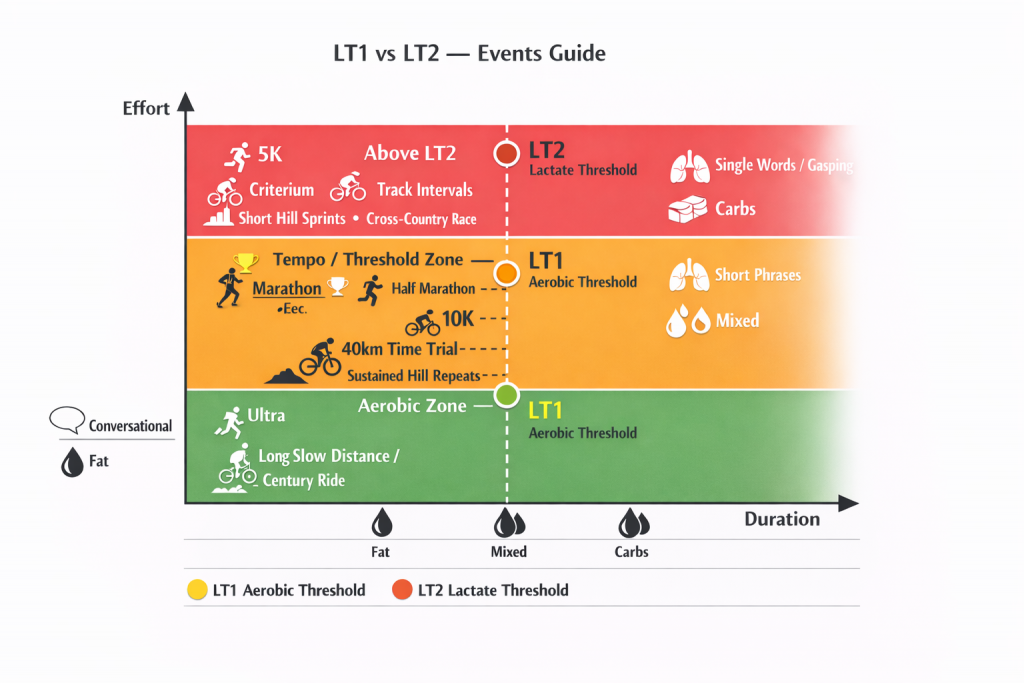
Each event in the diagram has a little runner or cyclist icon next to it, a quick visual cue to show which sport it belongs to.
I’ve also split marathon pacing into elite vs recreational, because they land in different zones:
- Elite marathon pace sits in the amber band, it’s tempo/threshold work, not easy.
- Recreational marathon pace often sits closer to the green zone, aerobic, steady and sustainable.
Use the diagram to figure out where your goal event lives and what kind of training stress it demands. It’s not just about distance, it’s about intensity.
When you look at this chart, think of each zone as a different “engine mode” your body switches between. In the green zone, everything runs aerobically, plenty of oxygen, mostly fat for fuel and a rhythm you could hold all day. Move into the amber zone and things get more purposeful: lactate rises a little, breathing deepens, and you’re burning a mix of fat and carbs as you settle into that strong, controlled effort that builds race pace. Push into the red zone and the body shifts gear again where carbs become the main fuel, lactate climbs quickly and the effort feels sharp and time‑limited. Each zone has a job and good training blends them so you build durability, raise your threshold and keep a bit of top‑end speed when you need it.
🟢 Below LT1 — Aerobic Zone
What it feels like: easy, steady, fully conversational. What’s happening metabolically:
- Your body is running almost entirely on aerobic metabolism, plenty of oxygen available, no rush.
- Fat is the primary fuel, with a small contribution from carbohydrate.
- Lactate stays at baseline, because production and clearance are perfectly balanced.
- Mitochondria are doing the heavy lifting, and this zone is where they grow, multiply, and become more efficient.
- Stress hormones stay low, so you can accumulate big volume without big fatigue.
Why it matters: this is the zone that builds durability, capillarisation, and the aerobic engine that supports everything else.
Finding LT1
Use these cues on your next easy session:
- Breathing deepens slightly but stays fully conversational
- Shoulders relaxed, posture easy
- RPE 3–4/10
- HR sits in your comfortable endurance range
- Power/pace feels smooth and repeatable
If unsure: Slow down until your breathing softens and you can talk freely. That’s LT1 territory.
🟠 Between LT1 and LT2 — Tempo / Threshold Zone
What it feels like: controlled but purposeful; you can talk in short phrases, but you’re working. What’s happening metabolically:
- Lactate begins to rise above baseline, but your body can still clear it almost as fast as it’s produced.
- Fuel use shifts to a mix of fat and carbohydrate, you’re burning more carbs now, but not exclusively.
- Oxygen is still available, but the system is under meaningful strain, so breathing deepens.
- This is the zone where your body improves its ability to buffer, shuttle, and reuse lactate, a huge performance driver.
- Muscle fibres start recruiting more Type IIa fibres (fast‑oxidative), which are key for race pace.
Why it matters: this is the “race‑specific” zone for events from 10K to marathon (elite), and the one that raises LT2 over time.
Finding LT2
Try these cues during a steady hard effort:
- Breathing strong but controlled
- Short phrases only
- RPE 7–8/10
- HR sits just below your “red zone”
- Pace/power feels demanding but sustainable for 30–40 minutes
If unsure: Hold a strong pace for 20 minutes. If you could extend it to 40 with focus, you’re near LT2.
🔴 Above LT2 — High‑Intensity Zone
What it feels like: hard, sharp, and unsustainable; single‑word answers only. What’s happening metabolically:
- Lactate production exceeds clearance, so levels rise rapidly.
- The body shifts heavily toward anaerobic glycolysis, meaning carbohydrate is the dominant fuel.
- Hydrogen ions accumulate, contributing to that familiar burn and loss of muscle coordination.
- Breathing becomes maximal as your body tries to buffer acidity and deliver oxygen.
- Fast‑twitch fibres (Type IIx) are recruited, powerful but fatigue quickly.
Why it matters: this zone develops VO₂max, neuromuscular sharpness and the ability to tolerate surges but it’s costly and needs careful dosing.
🧩 How the three zones fit together
- Green builds the engine.
- Amber teaches you to use the engine at race pace.
- Red sharpens the top end.
⚠️ Common Mistakes (and How to Avoid Them)
1. Training Too Hard on LT1 Days
Easy days drift into “kinda hard.” Fix: Use breathing cues, not pace. If you can’t talk freely, ease off.
2. Treating LT2 as a Hero Pace
Trying to “win” threshold sessions. Fix: LT2 is about control, not conquest.
3. Using Pace on Hilly Routes
Pace jumps around and pulls you out of the right zone. Fix: Use breathing, RPE, or power instead.
4. Ignoring Fatigue Signals
Thresholds shift when you’re tired. Fix: If breathing feels unusually strained, adjust the session.
5. Doing Too Much Threshold Work
More isn’t better — it’s just more. Fix: 1–2 LT2 sessions per week is plenty for most athletes.
🧭 How to Use LT1 and LT2 in Training
Training LT1
- Easy runs/rides
- Long endurance sessions
- Recovery days
- Aerobic development blocks
Outcome: A bigger aerobic base, better durability, and improved efficiency.
Training LT2
- Tempo runs
- Threshold intervals
- Race‑specific sessions
- Controlled hard efforts
Outcome: Better race performance, improved lactate clearance, and stronger sustained power.
🧩 Real‑World Examples
Athlete A — High LT1, Low LT2
Strong aerobic base but struggles to hold harder efforts. Training focus: Threshold development, controlled tempo work.
Athlete B — Low LT1, Strong LT2
Can push hard but fades in long sessions. Training focus: Aerobic volume, steady endurance, long LT1 work.
Coaching Insights
If you want to explore how these thresholds shape real‑world training decisions, here are two deeper dives:
- Individualising Endurance Training with AI‑Supported Coaching Workflows
- Why Two Similar Runners Need Different Training
These articles show how LT1 and LT2 guide session design, progression, and athlete profiling.
-
Track Speed vs Race Performance: The 5k/10k Truth
Smashing 200s but struggling in 5ks? You’re training the wrong system. Discover why your race…
-
Pace vs Power
Pace vs power: which metric really drives performance? This fast, science‑driven debate breaks down race…
-
Understanding Training Load and Adaptation
Ever wondered why you feel amazing after a few easy days? This guide explains how…
