
Functional Reserve Capacity: The Battery That Controls Your Race
Every runner has heard the phrases: “Burn a match!”, “Dig in!”, “Empty the tank!”. What most don’t realise is that these aren’t just motivational clichés, they describe a real physiological system that determines how hard you can surge, how long you can attack, and how much you can get away with at the start of a race.
That system is Functional Reserve Capacity (FRC), your anaerobic battery.
Once you understand how FRC works, how it drains, and how it recharges, pacing stops being guesswork. You’ll know exactly why fast starts feel great… until they don’t, and how to control your battery so you finish stronger, not slower.
This guide breaks down:
- Functional Reserve Capacity (FRC) — your total anaerobic work capacity
- dynamic Functional Reserve Capacity (dFRC) — your real‑time battery gauge
- Critical Power (CP) — the line between sustainable and unsustainable effort
- Why fast starts destroy races
- How many matches you can burn in a 10K
- How to train better pacing control
Let’s start with the battery itself..
Your Anaerobic Battery: What FRC Really Means

FRC represents the amount of work you can do above your Critical Power before your body is forced to slow down. Think of it as a finite store of energy that supports surges, climbs, accelerations, and fast starts.
Once this battery is empty, you can’t simply “try harder”. The physiology underneath it changes dramatically and performance drops.
FRC is:
- small compared to your aerobic system
- powerful, but short‑lived
- trainable, but only to a point
- critical for racing, especially in the first kilometre
Different athletes have different battery sizes. Sprinters and middle‑distance runners tend to have large FRC values. Endurance runners often have smaller ones, but they use them more strategically.
dFRC: The Live Gauge That Shows What You Have Left
If FRC is the size of your battery, dFRC is the live display showing how much remains at any moment.
When you run above CP, dFRC drains. When you run below CP, dFRC recharges but slowly and never fully during hard racing.
This real‑time gauge is incredibly useful because it shows:
- how much you spent at the start
- how much you have left for surges
- how close you are to blowing up
- whether your pacing is sustainable
In WKO, dFRC is displayed as a falling curve during hard efforts. When it hits zero, you’re out of anaerobic work capacity and your body transitions into a very different physiological state.
Functional Reserve Capacity (FRC): Why Starting Too Fast Ruins Your Race
If you’ve ever launched off the start line feeling unstoppable only to fade badly minutes later, you’ve experienced one of the most common endurance mistakes: starting too fast.
With running power, we can explain exactly why this happens using three concepts:
- FRC (Functional Reserve Capacity)
- dFRC (Dynamic Functional Reserve Capacity)
- Critical Power (CP)
Once you understand how these work together, pacing becomes predictable, controlled, and far more successful.
What FRC Actually Is
Before we get into tactics, let’s anchor the physiology. Understanding what FRC represents and how quickly it drains, is the key to controlling your race from the first step to the final kick.
FRC is your total anaerobic work capacity above Critical Power, measured in kilojoules.
It represents the amount of high‑intensity work you can do before your body forces you to slow down. Think of it as your hard‑effort battery:
- Surges
- Hills
- Overtaking
- Race starts
- Final kicks
When FRC hits zero, you’re done with anaerobic work your body locks you into a purely aerobic survival pace.
Knowing the size of your battery is useful, but racing happens in real time. That’s where dFRC comes in, the live display showing exactly how much of that battery remains as you run.
dFRC: The Live Gauge That Shows What You Have Left
If FRC is the size of your battery, dFRC is the live display showing how much remains at any moment.
When you run above CP, dFRC drains. When you run below CP, dFRC recharges but slowly, and never fully during hard racing.
This real‑time gauge is incredibly useful because it shows:
- how much you spent at the start
- how much you have left for surges
- how close you are to blowing up
- whether your pacing is sustainable
In WKO, dFRC is displayed as a falling curve during hard efforts. When it hits zero, you’re out of anaerobic work capacity and your body transitions into a very different physiological state.
Why Fast Starts Feel Great… Then Fall Apart
Most runners start too fast. It feels easy, controlled, even exciting. But inside your body, something very different is happening.
The moment you surge above CP:
- oxygen demand spikes
- VO₂ kinetics lag behind
- anaerobic contribution ramps up
- inorganic phosphate and hydrogen ions accumulate
- muscle contractile efficiency drops
- your battery drains rapidly
This is why fast starts feel brilliant for 400–800 metres… and catastrophic after 3–4 minutes.
Once your dFRC is heavily depleted, your body enters the severe domain, a physiological state where fatigue rises relentlessly and cannot be stabilised. You can’t “push through” this. You can only slow down.
How dFRC Depletion Actually Feels in Your Body
Different levels of depletion create different sensations:
High dFRC (full battery)
- legs feel springy
- breathing is controlled
- surges feel easy
- pace feels “free”
Mid dFRC (partially drained)
- breathing rises
- legs feel heavier
- surges cost more
- pace becomes harder to hold
This is why athletes often say: “I felt fine at the start, but the same pace suddenly felt harder.”
Low dFRC (near empty)
- legs feel blocked
- breathing is ragged
- no ability to respond
- pace collapses
This is the classic mid‑race feeling of: “I tried to go with the group but my legs wouldn’t respond.”
Zero dFRC (empty)
This is the moment athletes describe as: “My legs were gone.”
The Pacing Takeaway
“ Dr. Phil Skiba models, demonstrate that dFRC is an irrecoverable debt during steady-state racing. You should view your dFRC as a currency you only spend when you are absolutely ready to accept a permanent drop in systemic efficiency, or during the final sprint.”
A Real Session Showing FRC Drain in Action
Take a track session with repeated hard intervals above CP. The first rep feels great. The second feels manageable. By the third, your legs feel heavier. By the fourth, you’re fighting.
This isn’t mental. It’s your battery draining.
Recovery between reps only happens when you drop well below CP — and even then, you never fully recharge during a hard session.
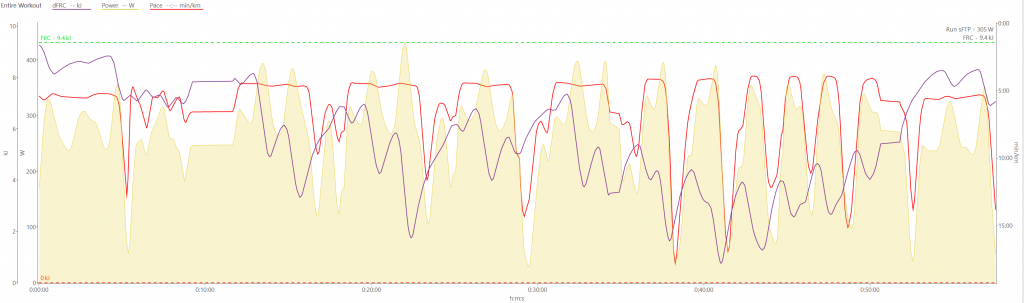
Session Breakdown
- Main Set
- 2 × 1 km @ 94–100% of Threshold Power Controlled threshold efforts designed to stabilise oxygen kinetics and establish race‑pace feel. Recovery: Easy jog between reps.
- 2 × 800 m @ 96–106% of Threshold Power Slightly above threshold to begin tapping into dFRC while maintaining form and rhythm. Recovery: Easy jog between reps.
- 2 × 400 m @ ~110% of Threshold Power Shorter, sharper efforts pushing into the severe domain. Noticeable dFRC drain here. Recovery: Easy jog between reps.
- 4 × 300 m @ 110–120% of Threshold Power High‑intensity repetitions designed to stress anaerobic capacity and simulate late‑race surges. Recovery: Controlled jog between reps.
- Athlete sFTP: 305 W
- Athlete FRC: 9.4 kJ
- What to notice:
- dFRC drains rapidly during above‑CP efforts
- Recovery only occurs when power drops well below CP
- The athlete never fully recharges dFRC once the main intervals begin
- This mirrors race behaviour: early mistakes cannot be undone at race pace
The Tactical Reality: Sometimes You Must Start Fast
In real racing, you can’t always start at perfect race pace.
Crowds, bottlenecks, terrain, adrenaline, and competition often force you to surge early. The goal isn’t to avoid fast starts entirely, it’s to control the cost.
A controlled fast start:
- uses a small portion of your battery
- settles quickly into race pace
- preserves enough dFRC for the final kilometres
An uncontrolled fast start:
- drains half your battery in the first kilometre
- forces you into the severe domain
- destroys your ability to finish strong
Your dFRC battery starts draining the moment you exceed CP, even if only by 10–20 watts.
So the real question becomes:
How Long You Can Run Above CP Before It Hurts You
So how long can you safely run above CP? It depends on:
- how far above CP you go
- your total FRC
- your aerobic fitness
- how quickly you settle back below CP
- course profile and terrain
Most runners can only sustain efforts significantly above CP for 2–4 minutes before dFRC depletion becomes performance‑limiting.
This is why the first kilometre of a 10K is so dangerous.
The Key Principle: dFRC Only Recharges Below CP, Not At Race Pace
If you start too fast and then “settle” at race power, you do not recover your battery. You simply carry the debt forward.
This is why the fast start must be:
- short
- controlled
- limited to one match
Once you understand the cost of each surge, you can plan how many “matches” you can afford and where to spend them.
How Many Matches Can You Burn in a 10K
A “match” is simply a chunk of dFRC.
Most runners have 3–6 matches in a 10K, depending on:
- FRC size
- CP
- fitness
- pacing discipline
- terrain
- race dynamics
Burning one match early is fine. Burning two is risky. Burning three in the first kilometre is race‑ending.
The best 10K runners spend their matches deliberately:
- one at the start (controlled)
- one mid‑race (terrain or tactics)
- one at the end (kick)
The Golden Rule for 10K Racing With Power
The first kilometre should be the cheapest kilometre of the race.
If you drain your battery early, you will pay for it physiologically.
**Start fast enough to secure position
but not so fast that you lose your final kick.**
More precisely:
Your fast start should burn no more than 10–20% of your W′.
This gives you:
- enough battery for mid-race control
- enough battery for a strong finish
- enough aerobic stability to avoid VO₂ drift
- enough margin to avoid catastrophic fade
How to Train Yourself Not to Start Too Fast
You can train pacing control. You can train CP. You can train FRC. You can train your ability to settle quickly after surges.
Key sessions include:
- controlled fast‑start intervals
- CP‑focused tempo work
- long intervals with strict pacing
- hill surges followed by steady running
- progressive runs with late accelerations
The goal is simple: teach your body to handle early intensity without draining the battery.
Final Takeaway
Everything in this guide comes down to one principle: starting too fast isn’t a pacing mistake, it’s a physiological debt.
- FRC is your anaerobic battery.
- dFRC is your real‑time battery
- CP is the line between sustainable and unsustainable
Start too fast and you drain the battery before the race has even begun. Start controlled and you preserve the power you need to finish strong.
Your best race isn’t about running harder, it’s about spending your battery wisely.
📘 Glossary of Terms & Abbreviations
Critical Power (CP)
Meaning: The highest power you can sustain aerobically without draining your anaerobic battery.
Context: Defines the boundary between sustainable and unsustainable running intensity.
Critical Speed (CS)
Meaning: Running equivalent of CP when using pace instead of power.
Context: Used in pace-based models; replaced by CP when using running power.
Functional Threshold Power (FTP)
Meaning: Approximation of CP used in some training systems.
Context: Common in cycling; also used in running power platforms.
Functional Reserve Capacity (FRC)
Meaning: Total anaerobic work capacity above CP, measured in kilojoules.
Context: Your “anaerobic battery” for surges, hills, fast starts, and finishing kicks.
W′ (W‑prime)
Meaning: Mathematical representation of FRC in kilojoules.
Context: Used in Skiba’s model and WKO5; identical concept to FRC.
dFRC (Dynamic Functional Reserve Capacity)
Meaning: Real-time measurement of how much of your anaerobic battery remains.
Context: Drains above CP, recharges below CP; displayed in WKO5.
W′bal (W‑prime Balance)
Meaning: Algorithm describing how W′ drains and recharges over time.
Context: Shows asymmetrical recharge: fast drain, slow recovery.
VO₂ (Oxygen Uptake)
Meaning: The rate at which your body uses oxygen during exercise.
Context: Becomes unstable above CP; drives the VO₂ slow component.
VO₂ Slow Component
Meaning: Progressive rise in oxygen cost even at constant power.
Context: Occurs when dFRC is used; makes threshold feel harder over time.
Severe Intensity Domain
Meaning: Exercise intensity above CP where steady state is impossible.
Context: Any use of dFRC places you here immediately.
Match
Meaning: A surge or effort that significantly drains dFRC.
Context: Runners can burn 1–2 matches in a 10K; elites 2–3.
Power-Duration Curve
Meaning: Model showing your maximal power for different durations.
Context: Used by WKO5 to calculate CP, W′, and dFRC.
Negative dFRC
Meaning: A modelling artefact where dFRC dips below zero.
Context: Indicates your power-duration model needs updating.
-
Pace vs Power
Pace vs power: which metric really drives performance? This fast, science‑driven debate breaks down race…
-
Understanding Training Load and Adaptation
Ever wondered why you feel amazing after a few easy days? This guide explains how…
-
Running Effectiveness
Running Effectiveness shows how efficiently you turn effort into speed. Learn how to measure it,…
