
This guide explains the four exercise intensity domains, where the science came from and how coach‑scientist Steve Palladino turned decades of research into a system runners can actually use. Because My Best A Race uses Palladino’s Zones as a descriptive framework, it’s useful to understand where they came from and what they really mean.
⭐ Why Intensity Domains Matter
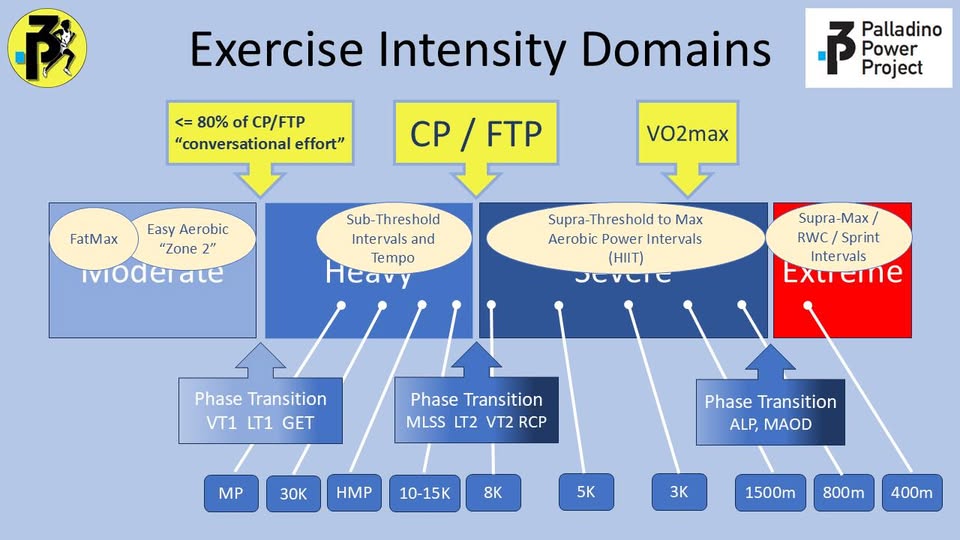
Think of the domains as your body’s four “running gears”:
- Moderate – easy running
- Heavy – steady/tempo
- Severe – VO₂max work
- Extreme – sprinting
Each gear feels different because your muscles behave differently. Different fuels, different fatigue rates, different limits.
🧠 Where This Science Came From
Korzeniewski & Rossiter (2022)
In 2022, Korzeniewski and Rossiter explained why the intensity domains exist. They showed that domain boundaries come from changes inside your muscle cells, specifically how phosphate compounds behave when intensity rises.
Think of it like your muscles switching energy modes.
Stephen Seiler (2000s-2010s)
Seiler didn’t discover the domains, but he made them famous. His work on polarized training brought the three‑zone model into everyday coaching. Palladino is clear that these zones are descriptive, not prescriptive.
Jones, Burnley, Vanhatalo (2000s-2020s)
Their research explains the Severe domain where VO₂ climbs toward VO₂max and time‑to‑exhaustion becomes predictable.
Monod & Scherrer (1965)
In 1965, Monod & Scherrer published the original maths behind Critical Power (CP), the line between Heavy and Severe. Their model has been refined for more than 60 years and remains central to modern endurance physiology.
Threshold researchers
Over decades, scientists identified familiar markers: LT1/LT2, VT1/VT2, MLSS, RCP, CP/FTP. All describe the same transitions your body goes through as intensity rises.
Before I explain the domains, here are the key physiological markers scientists use to identify the boundaries between them.
The Key Physiological Markers
LT1 — First Lactate Threshold
Marks the upper limit of truly easy running. Corresponds to the Moderate → Heavy transition.
VT1 — First Ventilatory Threshold
Breathing becomes more purposeful. Equivalent to LT1.
GET — Gas Exchange Threshold
Lab‑measured marker of the first phase transition. Equivalent to LT1 and VT1.
LT2 — Second Lactate Threshold
Marks the Heavy → Severe boundary. Often (incorrectly) called “anaerobic threshold”.
“Anaerobic threshold” is outdated. The body never becomes fully anaerobic, and lactate is produced aerobically. What people used to call ‘anaerobic threshold’ is actually the second phase transition.
VT2 — Second Ventilatory Threshold
Breathing becomes deep and laboured. Equivalent to LT2.
MLSS — Maximal Lactate Steady State
The highest intensity at which lactate can stabilise. Another Heavy → Severe marker.
RCP — Respiratory Compensation Point
Ventilation increases disproportionately to CO₂ production. Heavy → Severe marker.
CP / FTP — Critical Power / Functional Threshold Power
CP and FTP are conceptually the same. Both identify the second phase transition, the boundary between Heavy and Severe. Below CP/FTP, steady state is achievable; above it, fatigue arrives predictably in minutes. CP/FTP depends on protocol, execution, and modelling. CP is paired with W′ (Reserve Work Capacity), which determines how much work you can do above CP.
🔍 The Four Domains (Explained Simply)
1. Moderate – “Easy Running”
Below LT1/VT1/GET (Gas Exchange Threshold)
- You can chat
- Lactate stays low
- Effort feels easy
- VO₂ is steady
- You can run for hours
Palladino Zones inside Moderate
- 1a Post‑Interval Recovery
- 1b Easy Warm‑Up
- 1c Easy Aerobic Running
- 2 Endurance / Long Run
Perfect for:
Ultra‑marathon, long steady runs, aerobic base building, endurance triathlon runs.
2. Heavy – “Steady / Tempo / Sub‑Threshold”
Between LT1 and LT2
- Controlled but purposeful
- Lactate rises but stabilises
- VO₂ drifts upward
Palladino Zones inside Heavy
- 3a Extensive Threshold
- 3b Intensive Threshold
Perfect for:
Marathon, Half marathon, 10K, tempo runs, cruise intervals, threshold work.
3. Severe – “VO₂max Work”
Above LT2/VT2/RCP
- No steady state
- VO₂ climbs toward max
- Fatigue in minutes
Palladino Zones inside Severe
4 Supra‑Threshold 5 Maximal Aerobic Stimulus
Perfect for:
5K, 3K, mile (part Severe), hard hill climbs.
4. Extreme – “Sprinting / Anaerobic Capacity”
Above VO₂max
- Uses anaerobic capacity
- Very short efforts
- Burns through W′/RWC
Palladino Zones inside Extreme
- 6 Anaerobic Power
- 7 Sprint / Maximal Power
Perfect for:
400m, 200m/100m, hill sprints, finishing kicks. Rule: <60‑second efforts live in Extreme.
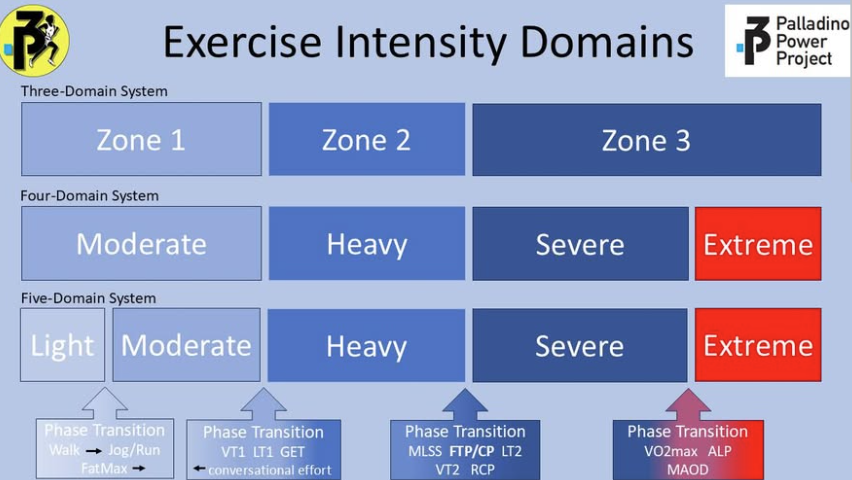
Some physiologists also use a five‑domain model, which simply adds a “Light” domain below Moderate. This doesn’t change the underlying physiology, it just gives extra clarity for very easy efforts like walking, recovery jogging, or FatMax work. The boundaries stay the same: Light and Moderate sit below the first phase transition, Heavy sits between the first and second transition, Severe sits above the second transition, and Extreme covers sprinting. It’s the same science, just with one extra descriptive layer.
🏃♂️ Where Steve Palladino Fits In
Palladino organised domains into a system runners can actually use. Zones are descriptive, not prescriptive. Good coaching requires specific targets inside the domain, marathon power, half‑marathon power, 15–16 km power are all Heavy domain but all different.
This is exactly how My Best A Race uses Palladino’s work: zones help athletes understand physiology; prescription comes from precise intensities within those zones.
To understand the Heavy → Severe boundary properly, we need to look at CP/FTP, the mathematical version of the second phase transition.
What CP/FTP Really Means
Many runners hear “CP” or “FTP” and assume they’re cycling terms. In reality, they’re simply ways of identifying one of the most important boundaries in endurance physiology: the line between Heavy and Severe intensity domains.
CP = Critical Power
A mathematical model first published by Monod & Scherrer in 1965.
FTP = Functional Threshold Power
A term introduced by Dr Andrew Coggan in 2003, originally defined using CP modelling.
CP and FTP are conceptually the same.
Both identify the second phase transition, the point where your body switches from:
- slow fatigue → fast fatigue
- steady state → no steady state
- long sustainable efforts → short unsustainable efforts
This is the same boundary targeted by LT2, MLSS, VT2, and RCP.
Below CP/FTP: the Heavy domain (slow fatigue)
- You can reach metabolic steady state
- VO₂max is not reached
- Lactate rises but stabilises
- You can hold the effort for a long time (often >30 minutes)
This is where half‑marathon and strong tempo work live.
Above CP/FTP: the Severe domain (fast fatigue)
- No steady state
- VO₂ slow component drives toward VO₂max
- Fatigue arrives predictably in minutes
- Time to exhaustion (TTE) depends on how far above CP you go
This is where VO₂max intervals, 3K racing, and hard surges live.
CP/FTP is not a fixed number, it depends on how you test it
Steve Palladino emphasises this strongly:
- different protocols → different CP
- different execution → different CP
- different models → different CP
- different athletes → different TTE
- glycogen status → changes CP
This is why two runners can have the same CP but very different time‑to‑exhaustion at CP.
TTE at CP varies massively
Steve notes that TTE at CP can be:
- ~50 minutes ± 20 minutes
Elite athletes often last longer. Recreational athletes often last shorter.
This variability is normal and expected.
Critical Speed (CS) works the same way
CS is conceptually identical to CP, but simple rules like:
“CS = 30 minutes”
are not valid across mixed populations.
CP comes with W′, your “reserve work capacity”
CP is always paired with W′, which Steve Palladino calls Reserve Work Capacity (RWC).
W′ represents:
- your anaerobic battery
- how much work you can do above CP
- how hard you can surge
- how long you can sprint
- how you pace intervals above CP
Together, CP and W′ allow precise interval design and pacing above the second phase transition.
Why CP/FTP matters for runners
Because it identifies the exact point where:
- your physiology changes
- your fatigue behaviour changes
- your pacing strategy changes
- your interval prescription changes
- your race execution changes
It is the clearest, most reliable way to understand the Heavy → Severe boundary — and the most useful anchor for power‑based training.
Better race strategy
Different races live in different domains:
- Marathon → Moderate
- Half marathon → Heavy
- 5K → Severe
- 1500m → Extreme
Better use of running power
Palladino’s framework connects power → physiology → training. It’s the most coherent way to understand your running intensity.
And because My Best A Race uses Palladino Zones descriptively, you get a system that is:
- scientifically grounded
- easy to understand
- personalised in prescription
- consistent with modern physiology
🔧 The Simple Bridge: Physiology → Description → Prescription
Here’s the whole story in one line:
Scientists discovered the physiology. Seiler popularised the model. Palladino described it clearly. Coaches turn that description into training.
That’s the workflow behind modern running‑power coaching and the foundation of My Best A Race.
What Good Coaching Really Means
Good coaching isn’t about telling an athlete to “run in Zone X”. Zones describe the type of effort, but they don’t prescribe the right effort. Coaching starts with knowing the athlete, physiology, history, strengths, limiters, psychology, life load and knowing the demands of the event.
Coaching is choosing precise targets inside each domain:
- Moderate → durability and aerobic efficiency
- Heavy → sustainable speed
- Severe → VO₂max and surges
- Extreme → power and finishing ability
The coach blends these domains in the right proportions so the athlete arrives at race day with the exact engine their event requires. This is why My Best A Race uses Palladino’s descriptive zones: they help athletes understand physiology, while coaching provides the precision that turns understanding into performance.
📣 Final Takeaway
You don’t need a physiology degree to train well. You just need to understand the four domains, know what CP/FTP represents, and use descriptive zones to make sense of your effort. From there, good coaching turns those descriptions into precise, personalised training that helps you run your best race.
-
Running Made Simple: Understanding Intensity Domains
This guide explains the four exercise intensity domains, where the science came from and how…
-
Track Speed vs Race Performance: The 5k/10k Truth
Smashing 200s but struggling in 5ks? You’re training the wrong system. Discover why your race…
-
Pace vs Power
Pace vs power: which metric really drives performance? This fast, science‑driven debate breaks down race…
