
When Rest Makes You Fly: How Training Load and Adaptation Really Work
Ever had a week where training absolutely batters you… then you take a few easy days… and suddenly you’re flying?
That rebound isn’t magic. It’s your body adapting to training load, the rhythm of stress, fatigue, recovery, and performance that sits at the heart of endurance training.
This article breaks that cycle down in clear, runner‑friendly terms so you can understand why you feel the way you do and how to use it to train smarter.
The Feeling Comes First
Every runner knows these moments:
- Your legs feel heavy all week… then suddenly feel snappy.
- Your easy pace drops by 20–30 seconds without trying.
- You finish an easy recovery week and feel like you’ve levelled up.
These sensations aren’t random. They’re visible signs of how your body responds to training load, the stress you apply, the fatigue you carry, and the adaptation that follows.
The Science Behind the Feeling
In the early 2000s, Dr Andrew Coggan created a mathematical model describing how endurance athletes respond to training stress. It became the backbone of modern tools like TrainingPeaks and WKO.
Here are the key metrics runners see:
| Metric | Definition | What It Means |
|---|---|---|
| TLS (Training Load Score) | Stress applied today (duration × intensity). | Raw input for CTL/ATL. |
| CTL (Chronic Training Load) | 42‑day rolling average. | Long‑term adaptation — load you’ve mostly absorbed. |
| ATL (Acute Training Load) | 7‑day rolling average. | Short‑term fatigue — load you’re still adapting to. |
| TLB (Training Load Balance) | CTL − ATL | Freshness: negative = tired, positive = fresh. |
| CTL Ramp Rate | Week‑to‑week change in CTL. | Progress vs risk. |
These numbers don’t replace how you feel, they explain it.
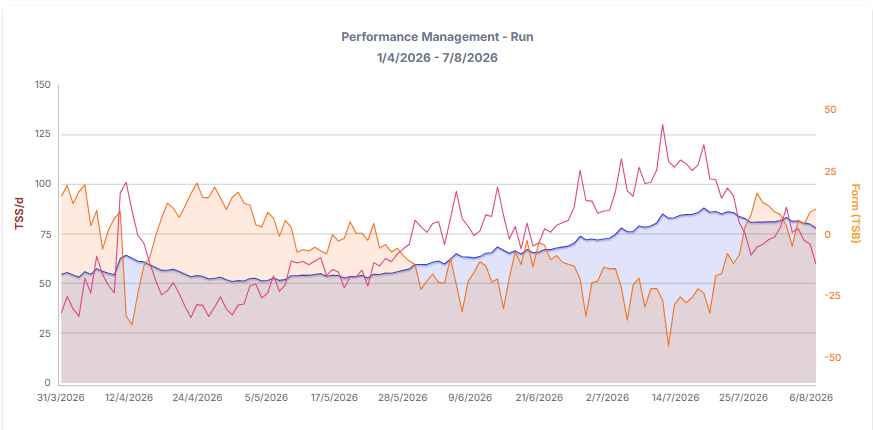
What you’re seeing:
The athlete’s Performance Management Chart in TrainingPeaks shows a well‑executed taper leading into their Ultra in the first week of August. Our target was a TLB of +15 on race day, slightly higher than the typical +10 you’d aim for before a half marathon or marathon. Given the demands of this particular Ultra, we wanted a touch more freshness without compromising durability. Through careful planning and controlled reductions in load, the taper delivered exactly what we intended.
- Blue line (CTL) — your long‑term fitness. It rises gradually as you accumulate consistent training.
- Purple line (ATL) — your short‑term fatigue. It spikes during harder weeks and drops quickly when you rest.
- Orange line (TSB) — your freshness.
- Positive = you feel good
- Negative = you’re carrying load
- Shaded areas — periods of higher or lower training stress. They help you see when load was building versus when recovery allowed freshness to return.
What to look for: When the purple ATL line drops after a big block, the orange TSB line rises, and your legs feel snappy. That rebound is your body revealing the fitness shown by the blue CTL line.
How TLS Is Calculated (Runner Version)
TLS measures the metabolic cost of today’s training, how hard, how long, and how costly the terrain was.
The formula:
Where IF (Intensity Factor) = NGP ÷ threshold pace.
This is why:
- A long easy run can score 150 TLS
- An interval session around 90 TLS
- A short VO₂max workout 70–80 TLS
TLS reflects physiological cost, not how a session feels.
Examples Runners Will Recognise
1. Interval Session — Quality, Controlled Load
- 10‑min warm‑up
- 6 × 3 min @ 5K effort (2‑min jog recoveries)
- 10‑min cool‑down
- Total: 58 min
- Threshold pace: 4:20/km
- NGP: 4:10/km
- IF: 0.96
- TLS: 89
High intensity, low volume → quality without overload.
2. Long Run — Low Intensity, High Load
- 2‑hour easy run
- Rolling terrain
- IF: 0.79
- TLS: 150
Long runs accumulate load through duration, not intensity. They steadily raise CTL without sharp fatigue spikes — the backbone of endurance training.
3. VO₂max Session — High Intensity, Surprisingly Low Load
- 12 × 1 min fast (1‑min jog recoveries)
- Warm‑up + cool‑down
- Total: 45 min
- IF: 0.98
- TLS: 73
VO₂max intervals feel brutal, but the total time at high intensity is short. Potent stimulus, compact load.
Why Terminology Matters
As Coggan’s model spread, platforms rebranded metrics:
- CTL → Fitness
- ATL → Fatigue
- TSB → Form
It sounds intuitive but can be misleading:
- “Fitness” isn’t just CTL
- “Form” doesn’t guarantee performance
The maths describes load, not feelings. Sticking with the physiology‑anchored terms keeps things honest.
How Adaptation Really Works
Think of CTL and ATL as two sides of the same coin:
- CTL → load you’ve already adapted to
- ATL → load you’re still adapting to
When ATL > CTL, you’re in overload, tired but stimulating adaptation. When ATL < CTL, fatigue fades and performance rebounds.
Rest doesn’t make you fitter, it reveals the fitness you’ve already built.
The Rhythm of Training Load
A simple four‑week pattern explains most training cycles:
Week 1: Hard training → ATL rises → tired
Week 2: More load → ATL > CTL → productive fatigue
Week 3: Cutback → ATL drops → TLB positive → flying
Week 4: Normal load → CTL rises → fitness improves
This rhythm is the engine of endurance training.
How Runners Can Use This
Build steadily
Aim for a CTL ramp rate of 3–8 per week. Spikes = injury risk.
Plan recovery weeks
Every 3–4 weeks, reduce load.
Expect fatigue when ATL > CTL
This is productive tiredness, adaptation in progress.
Expect freshness when ATL < CTL
Your best sessions often happen here.
Don’t chase “Form”
Chase consistent load + smart recovery.
Red Flags: ATL Too High
- Easy pace drifting slower
- Elevated HR on easy runs
- Heavy legs for 3+ days
- Disrupted sleep
- Flat mood
- Persistent niggles
Short‑term fatigue is too high.
Signs Adaptation Is Happening
- Easy pace drifting faster
- Lower HR at same pace
- Legs feeling springy
- Controlled workouts
- Rising confidence
CTL is doing its job.
Why Rest Works (Physiology in 4 Lines)
- Training creates stress and micro‑damage
- Rest enables repair and supercompensation
- ATL drops during recovery
- True fitness (CTL) becomes visible
Rest doesn’t make you weaker, it makes your fitness usable.
Athlete Summary
Why you feel great after rest: ATL (short‑term fatigue) drops, revealing CTL (long‑term adaptation).
What to watch:
- CTL ramp rate → steady beats spiky
- TLB → negative = fatigue, positive = freshness
Bottom line: Train hard. Rest smart. Let your body adapt — and fly.